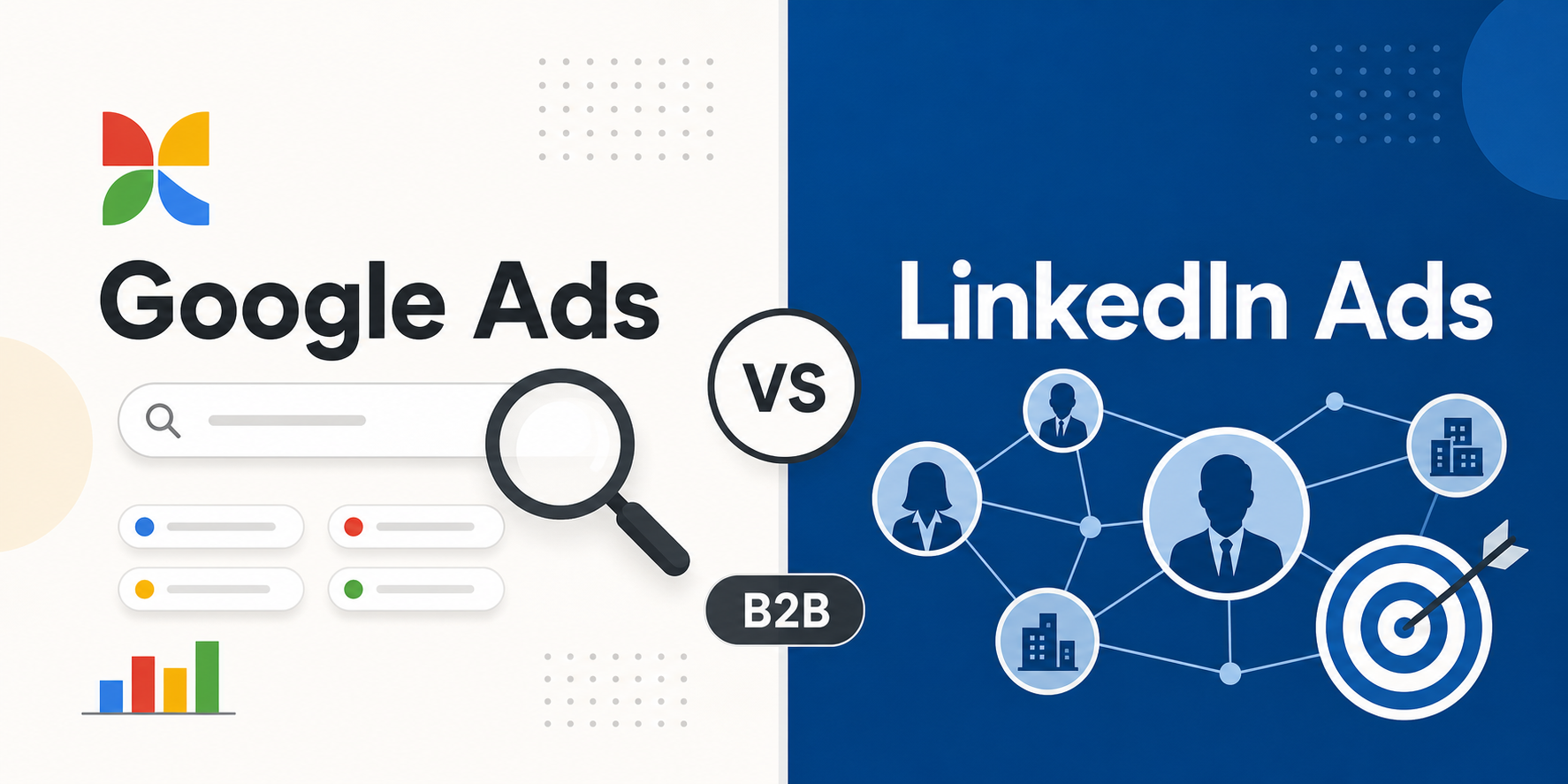
B2B companies lose pipeline not because they chose the wrong channel, but because they chose only one. The debate over using Google Ads vs LinkedIn Ads for B2B is costing B2B brands qualified pipeline at scale.
The ‘either/or’ budget conversation is a structural mistake. When finance asks marketing to justify spend, the instinct is to pick one channel: social for awareness or search for conversion. But this framing misunderstands how B2B buyers actually move. LinkedIn excels at demand generation while Google Ads captures demand that already exists, intercepting buyers who are actively searching for solutions. These are not competing roles. They are complementary stages of the same journey.
The real damage emerges when these channels operate in silos. When LinkedIn nurtures a senior decision-maker over three months, but your Google Ads campaign cannot attribute the eventual conversion back to that touchpoint, your pipeline reporting becomes fiction. Budgets get cut from the channel that built the intent, and rewarded to the one that simply harvested it. This is how brands quietly lose long-term pipeline and why understanding how buyers discover you across every surface matters more than ever.
What follows is a channel-by-channel breakdown, starting with the numbers that most marketing teams get wrong.
Decoding the Data: A Direct CPC and Intent Comparison for B2B
Any B2B PPC strategy must confront an uncomfortable truth: the cheapest click is rarely the most valuable one.
LinkedIn CPCs frequently run 3–5× higher than Google, yet for roles such as Head of Operations or VP of Engineering, the lead quality differential often justifies that premium. Targeting by company size, industry, seniority, and job function simultaneously is simply unavailable at the same precision on search platforms. You are not just reaching someone who typed a relevant query; you are reaching the exact person whose job title appears on your ideal customer profile (ICP).
Google operates on a fundamentally different logic. Search captures “hand-raisers”. Buyers actively researching a solution, often close to a decision. That intent signal is powerful. But it also means you are competing in an ad auction shaped by that same intent, driving up costs for high-value commercial keywords. LinkedIn, by contrast, pre-qualifies an audience earlier in the consideration cycle.
| Channel | Average CPC | Intent Level | Targeting Strength |
|---|---|---|---|
| Google Ads | Lower | High | Keyword-based |
| LinkedIn Ads | 3–5× higher | Low–medium | Industry, company & role-based |
This is precisely why cost per qualified lead, not cost per click, is the metric that matters across the B2B buyer journey. A €12 LinkedIn click that converts a CFO is cheaper than a €3 Google Ads click that attracts a junior role researcher. And as buying committees grow longer and AI-generated search overviews begin reshaping how buyers discover solutions, that distinction becomes even more consequential.
The AI Visibility Gap: How LinkedIn Ads Influence Generative Search
Social signals are quietly shaping which B2B brands appear in AI-generated answers and most marketers have not noticed yet.
Brand authority in LLMs is not determined solely by backlinks and domain ratings. Large language models are trained on web content, including professional discussions, industry commentary, and platform-level engagement patterns. A brand that appears frequently in substantive professional conversations is more likely to surface in AI-generated overviews as a credible reference point. LinkedIn is the most-cited domain for professional queries in AI search, according to a research conducted by Profound.
AI Visibility is fast becoming the third pillar of B2B search marketing, sitting alongside paid search and SEO. Brands that invest in LinkedIn today are, in effect, funding long-term organic recommendations inside AI-generated answers tomorrow.
Treat LinkedIn marketing efforts as an input to your AI visibility footprint, not just a pipeline metric. The brands that appear in generative search tomorrow are earning that visibility through social authority today.
Understanding how LinkedIn builds this kind of authority naturally raises the question of how to structure campaigns for maximum demand generation impact. This is precisely where account-based targeting and content-led creative come into play.
LinkedIn for Demand Generation
Most of your addressable market is not searching for your solution today. According to the B2B Institute, 95% of your market is not currently buying. LinkedIn reaches them before the intent exists.
The strongest LinkedIn campaigns lead with content, not conversion pressure. A “Book a Demo” CTA directed at a cold audience is one of the most reliable ways to waste budget. What tends to work better is a content-led sequence. Insight articles, benchmark reports, or short-form video that earns attention before asking for anything in return. This is how brands earn a mental foothold in the months before a buying cycle begins.
LinkedIn does not close deals directly; it plants the seed: forwarded articles in private Slack messages, and word-of-mouth recommendations that leave no trackable click but absolutely influence the final Google search that converts.
The platform’s account-based marketing capabilities make precise audience construction possible in ways no search network can replicate:
- Job function and seniority targeting — reach CFOs, Heads of Engineering, or IT Directors without wasted spend on junior roles outside the buying committee.
- Company size and industry filters — isolate mid-market accounts or enterprise segments that match your ideal customer profile.
- Matched audiences and contact list uploads — layer first-party CRM data on top of LinkedIn’s professional graph for surgical account-level reach.
And this is precisely where the handoff to Google Ads becomes strategic rather than coincidental.
Google Ads for Demand Capture: Closing the Loop on Search Intent
Google Ads is not typically where B2B brands build awareness. It is where they close the deals that awareness has already made possible.
The role of Google Ads in a mature B2B marketing strategy is to capture intent, not create it. When a procurement lead types “best project management software for engineering teams” into Google, they are not discovering a category. They are ready to evaluate. Search queries that are high-intent, commercial. This is where Google Ads earns its place in the budget.
Demand capture vs. demand creation is a distinction that many teams still blur. A common pattern is to run Google Ads in isolation, targeting certain keywords, and then measuring success by click volume rather than pipeline contribution. Successful B2B brands make a deliberate shift away from vanity metrics like clicks and impressions, focusing instead on qualified pipeline and revenue.
SEO and paid search tend to work better together than apart. Owning both the organic and paid positions on a high-intent search result reinforces credibility and compounds visibility. This is particularly relevant as AI visibility for B2B brands becomes a competitive frontier.
Knowing how to close demand through Google is only half the equation. The other half is deciding how to allocate budget intelligently across both channels, which is where a clear strategic framework becomes essential.
A Strategic Framework for B2B Ad Budget Allocation
A full-funnel approach ensures marketing spend translates directly into qualified pipeline rather than just traffic.
LinkedIn builds the brand; Google captures the demand it creates. These two platforms are not rivals competing for the same budget line. They are sequential forces in a single growth engine. LinkedIn shapes perception, earns trust, and influences future buying decision. Google then reaches the buyers that process has already moved to action.
- Brand and demand are separate jobs. LinkedIn is where you invest in category authority and long-cycle influence. Google is where you close what that influence has already warmed.
- Attribution must reflect total impact. Last-click models systematically undervalue LinkedIn, making it appear wasteful when it is often the engine behind your Google conversions. Multi-touch and revenue-based attribution tells a truer story.
- Budget split should follow market maturity. In an emerging category with low awareness, weight spend towards LinkedIn. In a mature market where buyers already know what they need, Google captures more of that intent efficiently.
- Misalignment between channel role and channel spend is the most common reason CAC inflates. Assign each platform the job it is built for.
Moving Beyond Clicks to Revenue-Driven Marketing
Sustainable B2B growth requires more than choosing the right ad platform. It need a unified strategy where paid search, paid social, SEO, and Generative Engine Optimisation (GEO) work in together.
The brands that win are those treating every channel as part of a single revenue system, not a collection of isolated channels. Google Ads effectively captures intent that LinkedIn has warmed. LinkedIn builds the audience that makes Google Ads profitable. And beneath both, SEO ensures your site earns the organic visibility that reduces dependence on paid advertising over time.
B2B GEO is increasingly important in that mix. As AI-powered search surfaces answers directly within results pages, B2B buyers encounter your brand before they ever click an ad.
For CMOs navigating this complexity, the practical risk is not choosing the wrong platform. It is allocating budget without a framework that connects channel activity to revenue outcomes.
Image source: Adobe Firefly (Generated with AI)
Disclaimer: I used AI tools such as Claude and Perplexity while creating this article. As a non-native speaker of the English language, I used it mainly to correct grammar mistakes etc.